Attrition has always been a challenge in the legal industry, but recent data shows that the problem has escalated into a full‑scale financial and operational threat. Law firms are losing associates earlier, more frequently, and at a higher cost than ever before, and the firms that fail to adapt are paying for it in profitability, client satisfaction, and institutional stability.
The True Cost of Losing an Associate
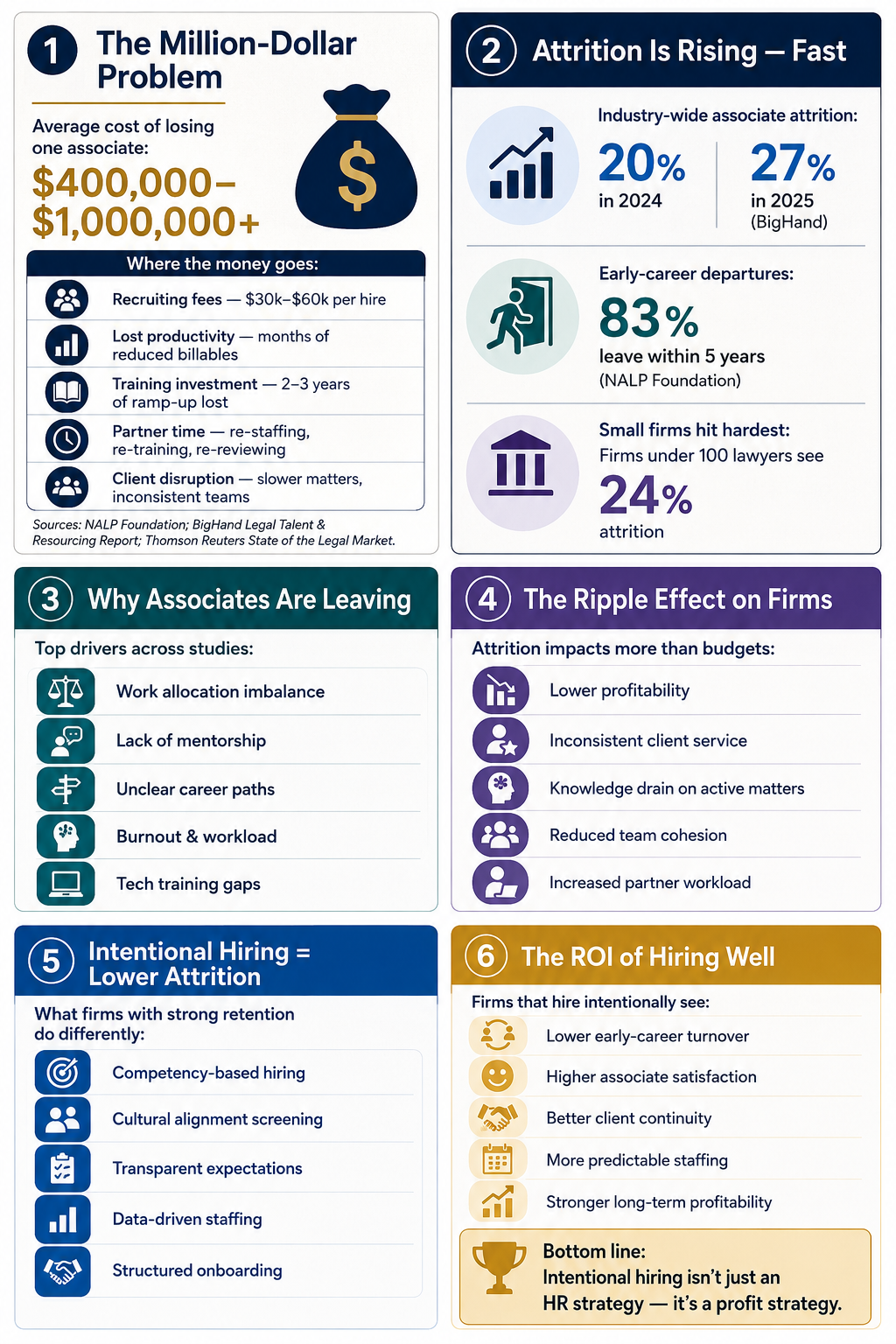
Multiple industry studies now confirm what many managing partners have long suspected: losing even a single associate can cost a firm more than $1 million. BigHand’s 2025 Legal Talent & Resourcing Report found that the fully loaded cost of losing a third‑year associate, including recruiting, onboarding, training, lost productivity, and knowledge transfer, now exceeds $1 million.
This figure is not an exaggeration. It reflects:
- Recruiting fees often ranging from $30,000–$60,000
- Months of reduced efficiency during onboarding
- Two to three years of training investment walking out the door
- Productivity gaps while searching for a replacement
- Partner and senior associate time spent re‑staffing matters
- Loss of institutional knowledge on active cases
As Counsel Index reports, firms are “hemorrhaging this sum thousands of times per year,” with attrition rising to 20% in 2024 and industry‑exit rates jumping from 9% to over 16% in 2025.
Attrition Is Getting Worse and Earlier
The NALP Foundation’s 2025 Update on Associate Attrition and Hiring shows that 83% of associates who left their firms did so within five years of hire, up from 80% the year before.
This means firms are losing talent before they recoup their investment and long before associates reach peak productivity. Smaller firms (100 or fewer attorneys) are hit even harder, with attrition rates of 24%, significantly higher than larger firms.
Why Are Lawyers Leaving?
Across studies, several themes emerge:
- Poor work allocation: Over one‑third of resourcing decisions are based on partner preference rather than skill or capacity, leading to burnout and dissatisfaction.
- Lack of mentorship and career development: Associates report unclear advancement paths and insufficient guidance.
- Misalignment between expectations and reality: Gen Z lawyers increasingly prioritize work‑life balance and in‑house roles over the traditional partnership track.
- Insufficient support for new technologies: The NALP Foundation notes that the lack of training in AI tools is now influencing associates’ decisions to leave.
These issues are not solved by raising salaries, a tactic many firms rely on. Compensation alone cannot fix structural problems in culture, workload, and development.
The Hidden Impact on Profitability and Client Service
High attrition doesn’t just drain budgets. It disrupts client relationships and erodes institutional knowledge.
BigHand’s research shows firm‑wide attrition has reached 27%, affecting service quality and profitability across all seniority levels.
When associates leave:
- Clients experience inconsistency in staffing
- Matters slow down as new attorneys ramp up
- Partners spend more time training and less time billing
- Teams lose cohesion and efficiency
In a competitive market, these disruptions can cost firms far more than the direct financial loss of replacing an associate.
Intentional Hiring: The Most Effective Retention Strategy
While retention programs are essential, the most powerful lever firms have is intentional, deliberate hiring. Hiring the right people, not just the available people, reduces attrition at its source.
What Intentional Hiring Looks Like
- Competency‑based evaluation Move beyond pedigree and GPA. Assess candidates on skills, communication style, adaptability, and alignment with practice‑group needs.
- Cultural alignment screening Associates who understand and embrace a firm’s culture are more likely to stay and thrive.
- Transparent career path discussions Setting expectations early reduces the mismatch between what associates want and what firms offer.
- Data‑driven staffing models Firms that use technology to match work to skills and capacity see higher engagement and lower burnout — a key factor in retention.
- Structured onboarding and mentorship Early support increases confidence, competence, and long‑term loyalty.
The ROI of Getting Hiring Right
Intentional hiring is not just an HR initiative; it is a strategic investment.
Firms that hire deliberately:
- Reduce early‑career attrition
- Improve associate utilization and satisfaction
- Strengthen client relationships
- Protect profitability
- Build a more stable, engaged workforce
Given that 74% of departing associates leave within their first four years, the payoff for better hiring practices is immediate and substantial.
Final Thoughts
Attrition is no longer a background issue. It is a million‑dollar problem reshaping the legal industry. Firms that continue to rely on outdated hiring models and subjective staffing decisions will fall behind. Those that embrace intentional, data‑driven hiring and development practices will not only reduce attrition but also build stronger, more resilient teams.
In a market where talent is the most valuable asset, hiring well is the ultimate competitive advantage.